



You invested time, money, and energy into your website. Maybe you had it professionally built. Maybe you put it together yourself on a weekend. Either way, it's out there representing your business 24 hours a day, 7 days a week.
But here's the question most small business owners never think to ask: is it actually doing its job?
Not just looking good. Actually performing, loading fast, ranking on Google, and turning visitors into paying customers.
Because here's the hard truth: a slow website isn't just annoying. It's quietly costing you money every single day. And the worst part? Most business owners have no idea it's happening.
The good news is there's a free tool that will show you exactly where your website stands in about 60 seconds flat. It's called PageSpeed Insights, it's made by Google, and by the end of this article you'll know how to use it (and what to do if your results aren't pretty).
Why Your Website Speed Matters More Than You Think
We live in an age of instant everything. Streaming, same-day delivery, contactless payments. Your customers' expectations have never been higher — and their patience has never been shorter.
Research by Google found that 53% of mobile visitors will abandon a website if it takes more than 3 seconds to load. Think about that. More than half of your potential customers are gone before they've even seen what you offer — just because your site was a few seconds too slow.
And it's not just about impatient visitors. Google itself uses your website's speed and performance as a ranking factor. That means a slow website doesn't just lose visitors — it gets buried in search results, making it harder for new customers to find you in the first place.
Speed affects trust, too. When someone lands on a sluggish, glitchy website, they don't think "oh, must be a technical issue." They think "this business doesn't look very professional." First impressions happen in milliseconds, and your website is often the very first impression a potential customer gets of your business.
Introducing PageSpeed Insights — Google's Free Performance Tool
PageSpeed Insights is a free tool built by Google that analyses your website and gives it a score out of 100. It looks at how fast your site loads, how smoothly it runs, how easy it is to use on a mobile phone, and a range of other factors that affect both user experience and search engine rankings.
The best part? You don't need to be technical to use it. Here's all you do:
- Go to pagespeed.web.dev
- Type or paste your website address into the box
- Click Analyse and wait about 30 seconds
That's it. Within half a minute you'll have a detailed report on how your website is performing — the same way Google sees it.
Understanding Your Score
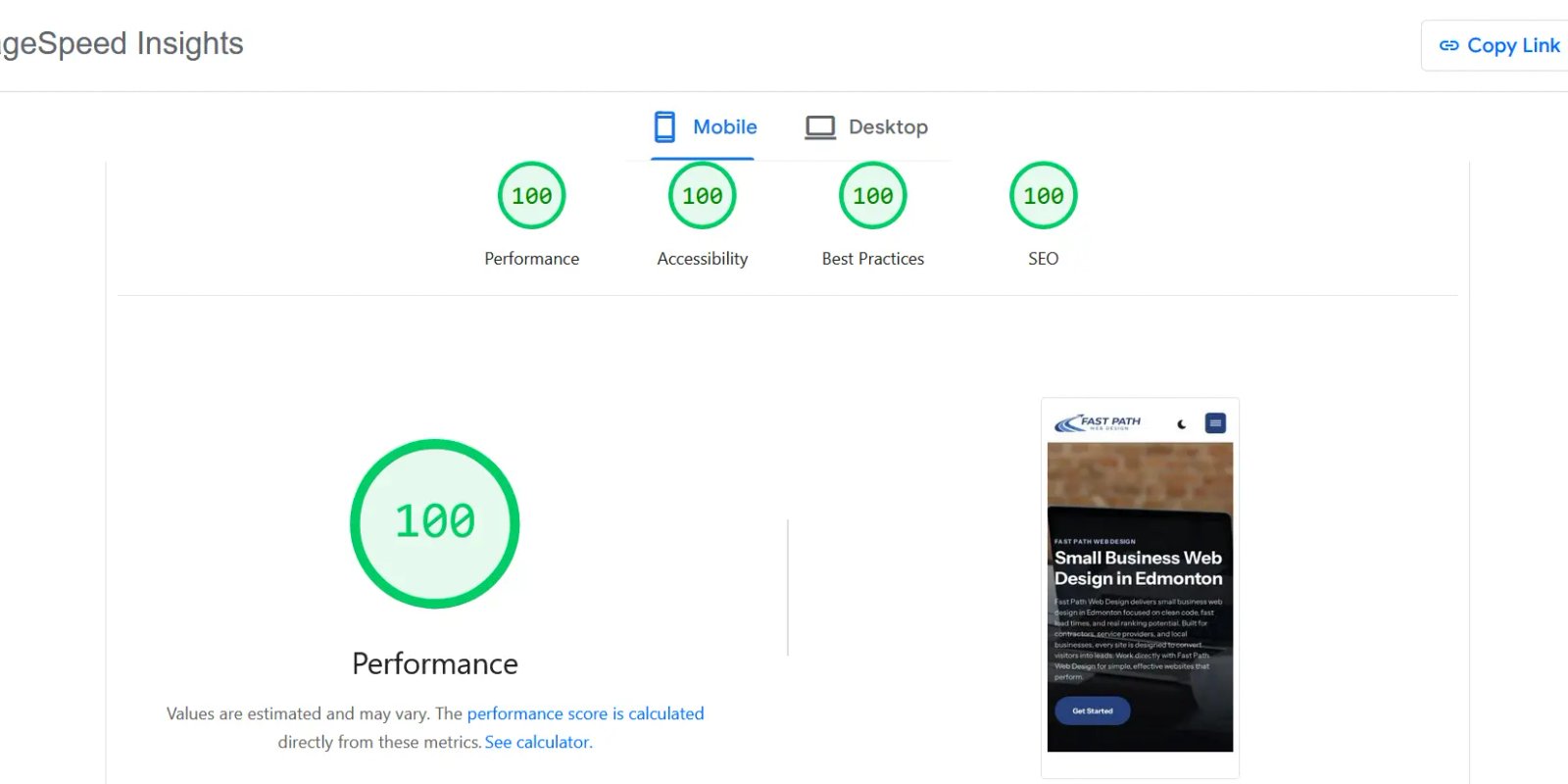
PageSpeed Insights gives you a score in four categories:
- Performance — How fast your site loads and runs
- Accessibility — How easy your site is to use for all visitors
- Best Practices — Whether your site follows modern web standards
- SEO — How well your site is set up to be found on search engines
Each score falls into one of three bands:
- 90 – 100 — Good ✅
- 50 – 89 — Needs Improvement ⚠️
- 0 – 49 — Poor ❌
The Performance score is the one to focus on first, as it has the biggest impact on your visitors' experience and your Google rankings.
Within the Performance section, you'll also see something called Core Web Vitals. These are three specific measurements Google uses to assess the real-world experience of using your website:
- LCP (Largest Contentful Paint) — How long it takes for the main content on your page to load
- INP (Interaction to Next Paint) — How quickly your site responds when someone clicks or taps something
- CLS (Cumulative Layout Shift) — Whether your page jumps around as it loads, which is both frustrating and unprofessional
Google officially uses Core Web Vitals as a ranking signal. If yours are in the red, it's directly affecting your position in search results.
How a Low Score Is Costing You Money
This is where it gets real. A poor PageSpeed score isn't just a technical problem — it's a business problem with a direct impact on your bottom line.
You're Losing Google Rankings
Google wants to send its users to websites that give them a great experience. A slow, poorly optimised site signals to Google that your website isn't up to scratch — so it pushes you down the rankings in favour of faster competitors. If you're not showing up on page one, you're essentially invisible to most potential customers.
Visitors Are Leaving Before They See Your Offer
Every second of load time increases the chance that a visitor gives up and goes elsewhere. Studies have shown that a one-second delay in page load time can reduce conversions by up to 7%. For a business making £10,000 a month from its website, that's £700 a month vanishing simply because the page loaded too slowly.
You're Wasting Your Advertising Budget
If you're running Google Ads, Facebook Ads, or any kind of paid traffic to your website, a slow site is like pouring water into a leaking bucket. You're paying for clicks, but a significant chunk of those visitors are bouncing before the page even finishes loading. You're paying full price for an experience your visitors never actually have.
Your Checkout or Enquiry Process Is Losing Sales
The closer someone is to buying, the less patience they have for friction. A slow product page or a checkout that takes forever to load is one of the most common reasons for abandoned purchases. A customer who was ready to buy will simply go and find a faster competitor.
You're Damaging Your Brand Without Knowing It
Think of your website like your shopfront. A slow, glitchy website is the digital equivalent of a shop with a broken front door, flickering lights, and staff who take five minutes to acknowledge you walked in. It doesn't matter how good your product or service is — the experience puts people off before they get a chance to find out.
What's Causing a Low Score?
If your PageSpeed score is in the red or orange, don't panic — you're far from alone. The majority of small business websites have performance issues, usually caused by a handful of very common problems:
Unoptimised images are the number one culprit. Many websites have images that are far larger than they need to be, forcing visitors to download huge files just to view a single page. Properly compressed images can dramatically improve load times with minimal visual difference.
Slow or cheap hosting is another major factor. Shared hosting plans might save you money upfront, but if your server takes too long to respond, every visitor pays the price. Your hosting is the foundation your website sits on — if it's shaky, everything built on top of it suffers.
Too many plugins or third-party scripts can quietly bloat your website. Each plugin, chat widget, social media button, and tracking script adds extra code that the browser has to load. Many website owners install tools they once needed and then forget to remove them — leaving behind digital dead weight that slows everything down.
Bloated website themes are especially common on platforms like WordPress. Many popular themes are packed with features and visual effects that look impressive in a demo but add significant load to your actual site.
No caching set up means your website is rebuilt from scratch every time someone visits, rather than serving a ready-made version. Proper caching can make a significant difference to load times without changing anything about how your site looks or works.
What You Can Do About It
Some performance improvements are things you can tackle yourself:
- Compress your images before uploading them using a free tool like Squoosh or TinyPNG
- Remove plugins you no longer use — if it's not actively doing something useful, get rid of it
- Check your hosting plan — if you're on the cheapest shared hosting available, it may be time to upgrade
- Run your site through PageSpeed Insights regularly — treat it like a health check you do every few months
Other improvements are better handled by a professional web developer. Things like optimising your Core Web Vitals, implementing proper caching, minifying your code, and restructuring how your site loads its resources require technical knowledge and can cause problems if done incorrectly.
This is exactly where working with a web professional pays for itself many times over. The cost of having your site properly optimised is almost always far less than the revenue you're losing to a slow, underperforming website.
The Bigger Picture — Why Investing in Your Website Pays Off
Fixing your PageSpeed score is just one piece of the puzzle. When you invest properly in your website — its speed, design, and overall quality — the benefits go far beyond just a better Google score.
Your website is the only piece of your online presence that you truly own. Your social media following, your marketplace listings, your ad accounts — all of these can be changed, restricted, or taken away at any time. Your website belongs to you, and a well-built one becomes one of your most valuable long-term business assets.
A fast, professional website builds trust before you've even spoken to a potential customer. Most people will visit your site before deciding whether to pick up the phone or send an enquiry. If what they find looks polished, loads quickly, and answers their questions clearly, they arrive in that first conversation already confident in your business.
It also works while you sleep. Enquiry forms, booking systems, and clear calls to action mean your website can generate leads and sales outside of business hours — without you lifting a finger.
From a visibility standpoint, a properly optimised website puts you in front of people who are actively searching for exactly what you offer. Unlike paid advertising, where the leads stop the moment you stop spending, good SEO and a well-performing site keep delivering results long after the initial investment.
And as your business grows, a well-built website grows with it. New services, new locations, new team members — a solid foundation means you can scale without having to start from scratch every couple of years.
The businesses that treat their website as an afterthought are the ones quietly losing customers to competitors who don't. The businesses that invest in it — even modestly — tend to see it become one of their most reliable and consistent sources of new work.
Take the Test Right Now
Here's your action step: before you do anything else today, go to pagespeed.web.dev, type in your website address, and see what Google actually thinks of your site.
Make sure you test the Mobile score, not just Desktop — the majority of web traffic now comes from phones, and Google primarily uses your mobile performance to determine your rankings.
If your score comes back green across the board — brilliant. You're in good shape.
If it comes back orange or red, now you know. And knowing is the first step to fixing it.
Not Sure What Your Results Mean?
PageSpeed Insights gives you a lot of information, and it can be overwhelming if you're not sure what you're looking at. That's completely understandable — it's a tool built for developers, not business owners.
If you'd like a plain-English explanation of your results and an honest assessment of what's holding your website back, I offer a free website performance review for small businesses. No jargon, no obligation — just a clear picture of where you stand and what, if anything, needs to change.
Invest in your website
A common error that many business owners fall into is viewing their website as an expense rather than an investment. A well-crafted website can result in a higher Google ranking, more leads and enquiries from the right people, a higher conversion rate and ultimately more money in your pocket. If a well-performing website than brings in clients interests you, then get in touch today to discover how we can revitalise your business website.
Get in touch today and let's take a look together.